Salima and Alain Cordeuil - the champagne you didn’t know you needed
The more you know, the more you realise you don’t know. When Aristotle said those words, he probably didn’t talk about champagne (or maybe he did, we weren’t there), but it’s a lesson I’m learning over and over. The world of champagne tends to surprise, giving you amazing cuvées from disastrous years, museums with tropical seashells and producers who put their wines to sleep at the bottom of the ocean*. But most of all, champagne surprises me by hiding brilliant makers to then introduce them to me as if I’ve been blind. It happened to me a few months ago, when I discovered the amazing Salima and Alain Cordeuil.
*Those examples come from respectively David Léclapart, Thibault Legrand-Latour and Leclerc-Briant.
In the autumn of 2025, I had dinner at Racine in Reims. It was a bit of a reunion, as I had met chef Kazu (Kazuyuki Tanaka) in 2021, when I joined David Léclapart’s harvesting team. Being a good friend of David, Kazu had cooked for us a few times that week, and it had left a lasting impression on me and my palate. Later, when visiting my favourite champagne hub Atome in Reims, I ran into his wife Marine, so when I finally walked into their restaurant I felt like I had always known the place. Marine and Kazu welcomed me and my partner with open arms, and when we sat down in the elegant and minimalistic dining area, I knew it would be a special night.
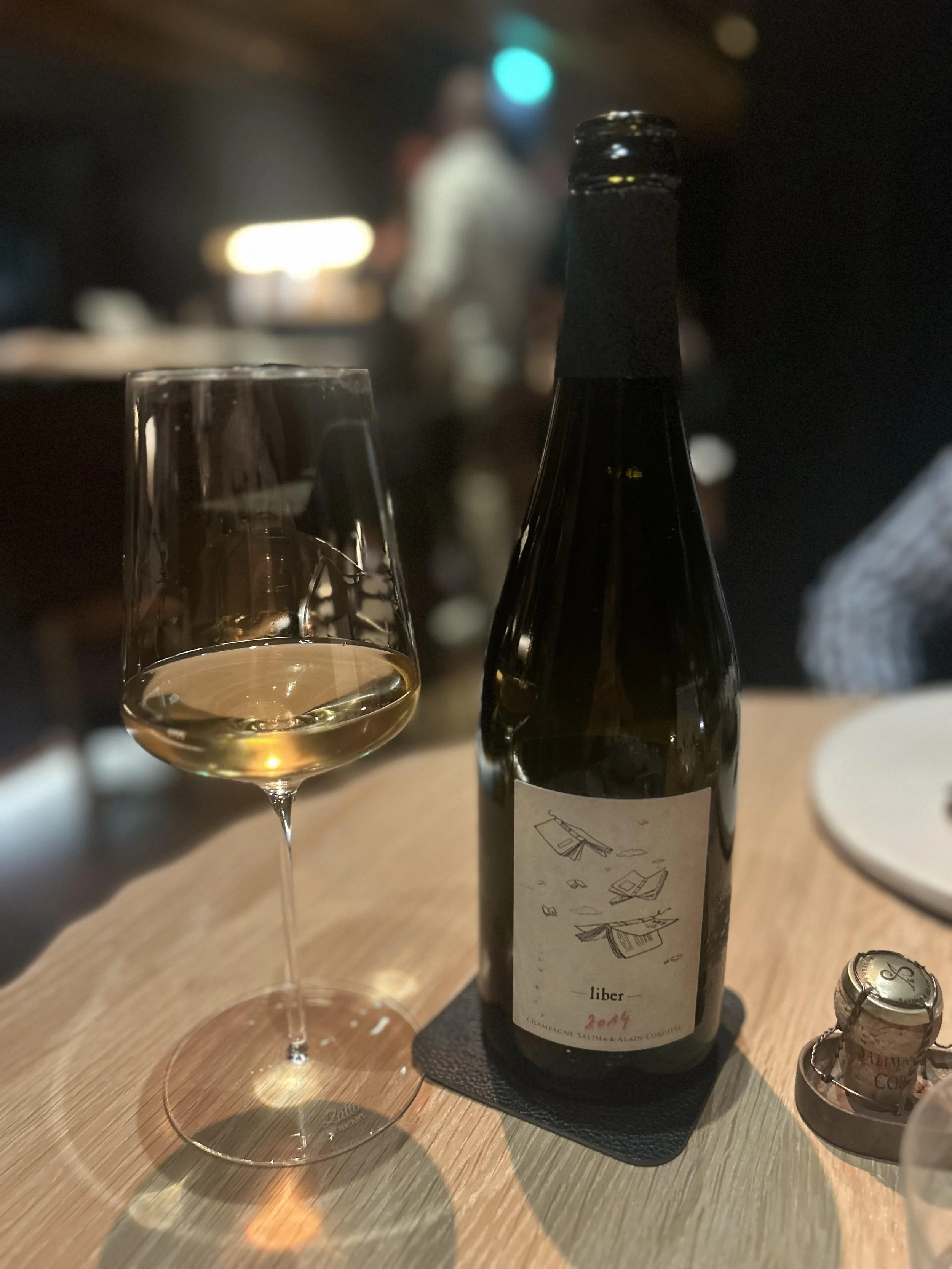
Liber 2014: “the” bottle
As always, I started scanning the wine menu for “the bottle”: the champagne that would accompany me throughout the Daisuki six course dinner. It’s what I always do in Champagne, as A. I’m in Champagne and B. I don’t do wine pairing as it makes me feel rushed. Japanese food is not my strong suit, though, and I didn’t quite know which direction to take. The scanning continued, and the more I thought about the perfect champagne, the more confused I got. I consulted the sommelier and we landed on an oxidative champagne that I can’t even remember the name of, but when he went to get it, it turned out it was no longer there. “May I suggest Cordeuil,” he said, pointing at a cuvée from 2014 called Liber. “It has that same oxidative note and will pair with the menu amazingly.” I had never heard of Cordeuil and didn’t feel like gambling with an unknown producer in such a good restaurant. Then again, I was in unknown territories anyway and the usual suspects couldn’t help me. I decided to live a little, and accepted.
The bottle came, and when it hit my glass I noticed the deep golden colour. I felt my muscles relax, an effect deep champagne tends to have on my nervous system. I held the glass in front of my face and was met with a scent of caramel and oak, of warmth and comfort. I felt my muscles relax some more. But the Cordeuil experience had only just begun. The first sip added orange, salted caramel, toffee and brown sugar. There was something deeply satisfying about this champagne, without it trying to be interesting; it just was. I looked over at my partner with disbelief, and saw my expression mirrored across the table. This was it. I put down the glass, looked at the sommelier and said: “From today on, I will trust you with my life.”
The Cordeuil domaine
So what did we just drink?
Salima and Alain Cordeuil are a producer’s couple from Noé-les-Mallets, a village in my beloved Côte des Bars in the south of the Champagne region. The area has some of the highest slopes in Champagne (ding ding ding!) and the couple has 4 hectares of vineyards. They started producing champagne in 2011 and are organically certified since 2015. Salima and Alain limit intervention to an absolute minimum, reject any chemical processes, and do not add any dosage. But their biggest trump is not their organic label or pure way of working - it’s time. Cordeuil champagne has an extremely long sur-lattes aging, which means the bottles rest with the lees (dead yeast cells) still in there after the second fermentation. This gives their cuvées a deep, profound character that also beautifully translates the terroir of their vineyards. Then, Salima and Alain let the bottles age in the cellar to further develop the champagne, up to a point where it will dazzle you from the first to the very last sip. I would know, as you might have guessed, the Liber cuvée we had at Racine stood up to all six courses.
Let’s make Cordeuil champagne great (again?)
All happy from my new discovery, I asked myself how come that in all these years, I had never heard of Salima and Alain Cordeuil. Sure, 4 hectares is not a lot, and small producers don’t usually do a lot of marketing, but this champagne deserved a podium. Then I realised that maybe this was all part of the Cordeuil vision: time. Maybe Salima and Alain simply take their time, and trust that the right people will find their creations when they’re ready. And now that I found them, I’ll happily do my part by writing about it. After all, when champagne has had the time it needed to age and develop, the waiting can stop.
Liber - 2014
| Location | Grape varieties | Spicy detail | Dosage |
|---|---|---|---|
| Noé-les-Mallets | 100% Pinot Noir | Extreme long sur lattes ageing | Brut nature |
Origines
| Location | Grape varieties | Spicy detail | Dosage |
|---|---|---|---|
| Noé-les-Mallets - Val Prouse and Hauts de Morival | 65% Chardonnay, 35% Pinot Noir | Plot age 65 years | Brut nature |
Clair Obscur
| Location | Grape varieties | Spicy detail | Dosage |
|---|---|---|---|
| Noé-les-Mallets | Pinot Noir and Chardonnay | Two blended plots | Brut nature |
Altitude 320 m
| Location | Grape varieties | Spicy detail | Dosage |
|---|---|---|---|
| Noé-les-Mallets | Pinot Noir | South facing | Brut nature |
Altitude 350 m
| Location | Grape varieties | Spicy detail | Dosage |
|---|---|---|---|
| Noé-les-Mallets | Chardonnay | Western exposure | Brut nature |